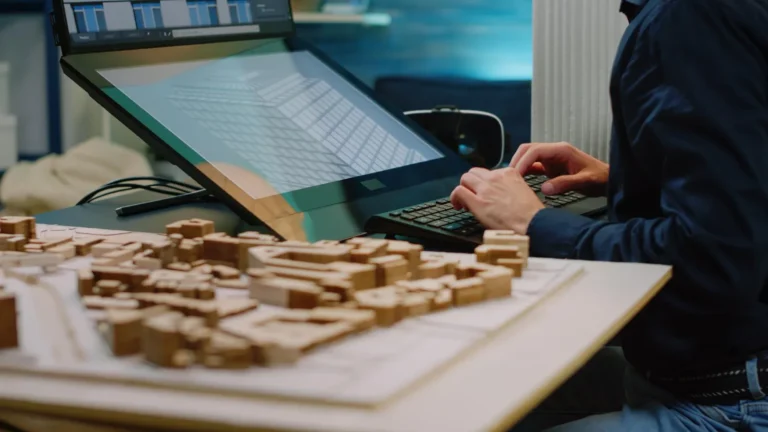

Precision in Every Line, Clarity in Every Component
Manufacturing drawings, also known as production or shop drawings, are detailed technical documents used in mechanical design and manufacturing that provide comprehensive information necessary for the fabrication, assembly, and inspection of mechanical components or systems. These drawings serve as a blueprint for machinists, engineers, and technicians to produce a part or product accurately.
Lab Automation
Behind the Scenes of a Smart Lab: The Role of Firmware in Modern Laboratory Automation
Manufacturing Drawings
Manufacturing drawings, also known as production or shop drawings, are detailed technical documents used in mechanical design and manufacturing that provide comprehensive information necessary for the fabrication, assembly, and inspection of mechanical components or systems. These drawings serve as a blueprint for machinists, engineers, and technicians to produce a part or product accurately.
3D Modeling Designing
3D modeling in Mechanical Design and Manufacturing refers to the process of creating three-dimensional representations of mechanical components or entire systems using specialized software. This process is crucial in modern engineering and manufacturing because it helps designers visualize, simulate, and refine products before physical production begins.
Solutions Expertise Into..
Product Design
It refers to the process of conceptualizing, developing, and engineering mechanical systems, components, or products with a focus on functionality, manufacturability, and performance.

Electrical Drawings
It refers to the functionalities and features of software tools that aid in creating, managing, and utilizing electrical schematics and diagrams.

3D Modelling and Assembly
Creating three-dimensional representations of mechanical components and systems, facilitating the design, analysis, and manufacturing processes.

CNC Machining Jobs
CNC machining jobs in mechanical design and manufacturing involve using CNC technology to produce precision parts and components based on computer-aided designs.

Injection Moulding
Injection molding is a widely used manufacturing process in mechanical design for producing parts and products from thermoplastic and thermosetting materials.
Domains we serve
Lab Automation
Lab Automation refers to the use of technology to perform laboratory tasks and processes with minimal human intervention.
Cheminformatics
We have worked in ChemInformatics niche providing services in data mining and analysis, chemical structure representation..
Synthetic Biology
Synthetic Biology involves the design and construction of new biological parts, devices, and systems, as well as the re-design of existing natural biological systems..
Synthetic Biology
Synthetic Biology involves the design and construction of new biological parts, devices, and systems, as well as the re-design of existing natural biological systems..
Electronic Device Designing
Electronic device designing refers to the process of creating and developing electronic systems or products that serve specific functions..
Health Analytics
Health Analytics in Healthcare involves the use of data analysis tools and techniques to improve patient care, optimize operations..
Synthetic Biology
Synthetic Biology involves the design and construction of new biological parts, devices, and systems, as well as the re-design of existing natural biological systems..
Synthetic Biology
Synthetic Biology involves the design and construction of new biological parts, devices, and systems, as well as the re-design of existing natural biological systems..
FAQ
Frequently Asked Questions
UVJ Technologies is a software solutions and engineering services company — not a manufacturing unit or fabrication facility. We provide the domain expertise, software development capability, and engineering knowledge that mechanical design and manufacturing organizations need to design, simulate, optimize, and manage their products and production processes. Our clients are OEMs, product engineering companies, industrial machinery manufacturers, automotive and aerospace firms, medical device companies, and precision manufacturing organizations. We work within the client's existing tool environment and infrastructure — bringing the engineering and software expertise to make those systems deliver maximum value.
UVJ's mechanical design and manufacturing practice covers five core areas: Product Design — concept development, detailed engineering design, simulation, DFM analysis, and prototyping workflow support. Electrical Drawings — schematic design, documentation generation, error checking, and system integration. 3D Modeling and Assembly — component modeling, assembly simulation, rendering, and lifecycle data management. CNC Machining — toolpath logic, machining program development, real-time monitoring systems, and process optimization. Injection Molding — mold design support, flow analysis, process parameter optimization, and quality control systems. In all areas, UVJ works within the client's licensed toolchain, contributing software development and domain engineering expertise rather than supplying proprietary tools.
A Digital Twin is a continuously updated virtual model of a physical product, machine, or production system — synchronized with real-world sensor data to mirror actual behavior and predict future performance. In 2025–2026, Digital Twin adoption in manufacturing has become a primary competitive differentiator. UVJ builds Digital Twin software platforms that create and maintain live virtual representations of mechanical products and manufacturing equipment; integrate with IoT sensors on physical machines to synchronize real-world operational data in real time; simulate product performance under actual operating conditions to predict wear, fatigue, and failure events; support virtual commissioning of production lines before physical installation; enable remote monitoring and control of manufacturing assets; and generate continuous performance analytics that inform design improvements, process optimization, and maintenance scheduling. UVJ develops the integration layer, data pipeline, and analytics software — working alongside the client's existing licensed modeling and simulation tools.
Physical prototyping is expensive, time-consuming, and iterative — and the industry trend in 2025–2026 is decisively toward virtual prototyping, where digital simulation replaces or dramatically reduces physical builds. UVJ builds the software infrastructure that enables this transition: high-fidelity modeling environments where geometry, materials, and assembly constraints are defined with manufacturing-ready precision; structural integrity validation under load, vibration, and fatigue conditions without physical test rigs; thermal and fluid performance evaluation through simulation; kinematics and dynamics validation for mechanism design; virtual assembly environments where tolerance stack-up and assembly sequence are validated digitally before a physical part is made; and Digital Twin platforms where a virtual product model continues to be updated with real operational data throughout its lifecycle — enabling performance monitoring, predictive maintenance, and next-generation design improvement from a single unified model.
Related Blogs